Search This Blog

Showing posts with label USDA. Show all posts

Thursday, February 9, 2017

USDA Scientific Integrity Policy Scores “Top Grade” in New Report

From the #USDA:


U.S. Department of Agriculture (USDA) Agricultural Research Service (ARS) entomologist Jay Evans and postdoctoral research associate Ryan Schwarz use a microscope to look at spores of the honey bee fungal parasite Nosema ceranae
U.S. Department of Agriculture (USDA) Agricultural Research Service (ARS) entomologist Jay Evans and postdoctoral research associate Ryan Schwarz use a microscope to look at spores of the honey bee fungal parasite Nosema ceranae, which can replicate in cells lining the honey bee gut on Oct. 25, 2011. Photo by Stephen Ausmus.
“Top grade,” “strong,” “substantially strengthened,” and “significantly improved,” may sound like reviews you might read about consumer products such as smart phones or televisions. However, these are the actual terms used by the Union of Concerned Scientists (UCS) in its recent review of USDA’s updated Scientific Integrity Policy.
In a January 2017 report titled “Preserving Scientific Integrity in Federal Policymaking,” the UCS – a noted organization that represents the interests of the scientific community – gave USDA’s updated Scientific Integrity Policy (or SIP, for short) the highest rating assigned in a three-tiered rating system.  Additionally, based on USDA’s release of a new procedural manual to accompany the SIP, USDA was one of only five federal departments or agencies (out of 18 reviewed) to receive a “strong” rating for its procedures for responding to scientific integrity concerns.
The Department has had a sustained commitment to developing a comprehensive department-wide SIP aimed at ensuring the highest level of quality, accuracy, and openness in all aspects of our scientific and technological processes and analyses.  In 2011, USDA was among the first Federal departments to issue a scientific integrity policy.  In 2013, USDA issued a more detailed version of the policy.  Following issuance of an updated SIP in 2016 and an accompanying procedural manual, UCS blogged that USDA’s SIP merited a “top grade” because it was “significantly improved in the protections it provides for USDA scientists” and “substantially strengthened.”
The Department is pleased to receive recognition for its SIP, which is intended to instill public confidence in the excellence, transparency, and innovation of USDA’s scientific research and science-based public policymaking.  We have also taken several other demonstrable actions to foster a culture of scientific integrity, including:
  • Launching a Web-based training course on scientific integrity that has been completed by more than 18,000 employees;
  • Developing a Website to serve as a source of information on USDA’s scientific integrity policies, procedures, and activities;
  • Designating individuals in each of the Department’s component agencies to serve as Agency Scientific Integrity Officers, who are available to speak confidentially with employees about scientific integrity issues and work with them to resolve concerns; and
  • Designating an individual to serve as the Departmental Scientific Integrity Officer, who has responsibilities for providing leadership and coordination on scientific integrity-related issues across the Department.
At USDA, we know that scientific integrity is woven into the fabric of the research that we conduct and the decisions that we make.  We are glad that others recognize this as well.

USDA Blog » How 4-H Rocks for Missouri Youth of All Abilities

USDA Blog » How 4-H Rocks for Missouri Youth of All Abilities

Sunday, January 15, 2017

The Cost of Raising a Child

From the #USDA:


Families Projected to Spend an Average of $233,610 Raising a Child Born in 2015 infographic
Families Projected to Spend an Average of $233,610 Raising a Child Born in 2015.
USDA recently issued Expenditures on Children by Families, 2015. This report is also known as “The Cost of Raising a Child.” USDA has been tracking the cost of raising a child since 1960 and this analysis examines expenses by age of child, household income, budgetary component, and region of the country.
Based on the most recent data from the Consumer Expenditures Survey, in 2015, a family will spend approximately $12,980 annually per child in a middle-income ($59,200-$107,400), two-child, married-couple family. Middle-income, married-couple parents of a child born in 2015 may expect to spend $233,610 ($284,570 if projected inflation costs are factored in*) for food, shelter, and other necessities to raise a child through age 17. This does not include the cost of a college education.
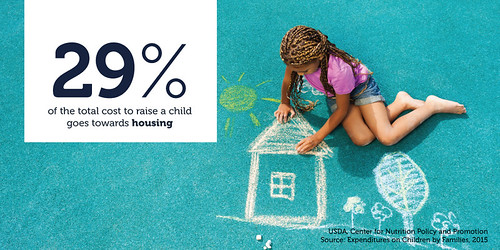
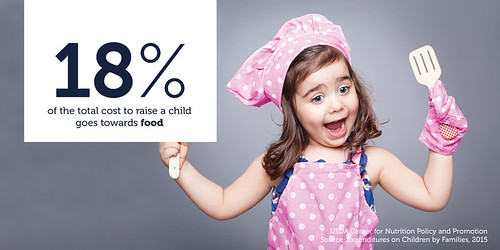
Where does the money go? For a middle-income family, housing accounts for the largest share at 29% of total child-rearing costs.  Food is second at 18%, and child care/education (for those with the expense) is third at 16%. Expenses vary depending on the age of the child.
CNPP Housing infographic
As families often need more room to accommodate children, housing is the largest expense.
We did the analysis by household income level, age of the child, and region of residence. Not surprising, the higher a family’s income the more was spent on a child, particularly for child care/education and miscellaneous expenses.
Expenses also increase as a child ages.  Overall annual expenses averaged about $300 less for children from birth to 2 years old, and averaged $900 more for teenagers between 15-17 years of age. Teenagers have higher food costs as well as higher transportation costs as these are the years they start to drive so insurance is included or a maybe a second car is purchased for them.
Regional variation was also observed. Families in the urban Northeast spent the most on a child, followed by families in the urban West, urban South, and urban Midwest.  Families in rural areas throughout the country spent the least on a child—child-rearing expenses were 24% lower in rural areas than the urban Northeast, primarily due to lower housing and child care/education expenses.
Child-rearing expenses are subject to economies of scale. That is, with each additional child, expenses on each declines. For married-couple families with one child, expenses averaged 27% more per child than expenses in a two-child family.  For families with three or more children, per child expenses averaged 24% less on each child than on a child in a two-child family.  This is sometimes referred to as the “cheaper by the dozen” effect. Each additional child costs less because children can share a bedroom; a family can buy food in larger, more economical quantities; clothing and toys can be handed down; and older children can often babysit younger ones.
CNPP Food infographic
Food costs have decreased over the years thanks to increased efficiency in American agriculture.
This report is one of many ways that USDA works to support American families through our programs and work. It outlines typical spending by families from across the country, and is used in a number of ways to help support and education American families.  Courts and state governments use this data to inform their decisions about child support guidelines and foster care payments.  Financial planners use the information to provide advice to their clients, and families can access our Cost of Raising a Child calculator, which we update with every report on our website, to look at spending patterns for families similar to theirs. This Calculator is one of many tools available on MyMoney.gov, a government research and data clearinghouse related to financial education.
This year we released the report at a time when families are thinking about their plans for the New Year.  We’ve been focusing on nutrition-related New Year’s resolutions – or what we are referring to as Real Solutions – on our MyPlate website, ChooseMyPlate.gov.  This report and the updated calculator can help families as they focus on financial health resolutions.  This report will provide families with a greater awareness of the expenses they are likely to face while raising children.
In addition to the report and the calculator, we also have a dedicated section on ChooseMyPlate.gov that provides tips and tools to aid families and individuals in making healthy choices while staying on a budget. For strategies beyond food, our friends at MyMoney.gov offer a wealth of information to help Americans plan for their financial future.
For more information on the Annual Report on Expenditures on Children by Families, also known as the cost of raising a child, go to: https://www.cnpp.usda.gov/expenditures-children-families-annual-report.
*Projected inflationary costs are estimated to average 2.2 percent per year. This estimate is calculated by averaging the rate of inflation over the past 20 years.
U.S. Department of the Treasury’s MyMoney.gov graphic
Visit the U.S. Department of the Treasury’s MyMoney.gov for more resources to ensure financial well-being this New Year’s season!

Wednesday, September 14, 2016

Don’t be a Zombie – Prepare for Emergencies

From the #USDA:


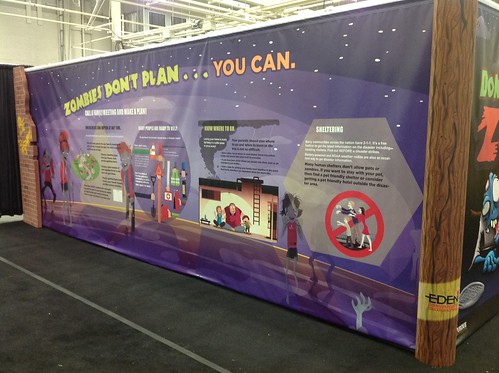
Purdue Extension’s “Don’t Be a Zombie” exhibit
Purdue Extension’s “Don’t Be a Zombie” exhibit is traveling the country to illustrate the need to prepare for emergencies. Photo by Abby Hostetler
In this guest blog, Abby Hostetler urges people to prepare for emergencies and describes an innovative display that Purdue Extension used at the Indiana State Fair to drive home that point. Because September is National Preparedness Month, it is a good time to think about emergency planning.  Don’t Wait. Communicate. Make an Emergency Communication Plan for you and your family because you just don’t know when disasters will impact your community.
By Abby Hostetler, EDEN Disaster Communications Specialist, Purdue University
Nearly 60,000 visitors to this year’s Indiana State Fair encountered zombies lurking around in the corners. Actually, they saw cartoon zombies that were part of an interactive exhibit, Don’t Be a Zombie – Be Prepared. The exhibit consists of a walk-though maze and interactive video game designed to simulate a zombie apocalypse.
The goal is to help families learn about disaster preparedness in a fun way. In 2011 the Centers for Disease Control and Prevention (CDC) launched their Zombie Preparedness campaign to much acclaim and success. The CDC campaign was a gory take on zombies and aimed at a teenage demographic. Once the Extension Disaster Emergency Network (EDEN) got permission from the CDC to adapt the materials into an interactive display, Purdue Extension used third grade classrooms to help tie into the rise of the zombie fad in pop culture while still keeping the materials friendly to all ages.
Purdue Agriculture’s Exhibit Design Center designed and built the maze and accompanying video game. In the video game, the player runs through a post-apocalyptic town collecting supplies for an emergency kit – while zombies are in hot pursuit. The exhibit ends at an underground storm shelter stocked with all the supplies necessary for survival in an emergency.
We hope that people leave the exhibit with four key points: be informed, create a family emergency plan, make an emergency supply kit, and practice and maintain your plan.
  • Be informed – know the threats and hazards to your community – flooding, earthquakes, wildfires, tsunamis, etc.
  • Make a family emergency plan – it should include everyone in your family, including pets, children, and seniors.
  • Make a 72-hour emergency kit — it should have enough supplies for everyone in your family and include (at least) non-perishable food, a first aid kit, a hand-cranked or battery-powered radio with weather alerts, and one gallon of water per person per day.
  • Practice and maintain your plans on a regular basis – a plan is only good if everyone knows it and it remains current.
The Don’t Be a Zombie exhibit will travel to museums across the country following the Indiana State Fair. The exhibit was developed by Purdue Extension in collaboration with EDEN, the nation’s premier source for disaster preparedness information, a one-stop shop of research-based educational material for all.  EDEN operates locally as part of the Cooperative Extension and Sea Grant Extension Systems’ efforts at each state’s land-grant and sea-grant universities.  The USDA National Institute of Food and Agriculture (NIFA) contributes funding each year through the Food and Agriculture Defense Initiative and Smith-Lever special needs grants.
NIFA invests in and advances agricultural research, education and extension and seeks to make transformative discoveries that solve societal challenges.

Wednesday, August 31, 2016

USDA Proudly Supports the LGBT Community in Oregon and Nationwide

From the USDA:


Rural Development State Director Vicki Walker staffing the USDA booth at the Eugene/Springfield Pride Festival
Rural Development State Director Vicki Walker staffing the USDA booth at the Eugene/Springfield Pride Festival along with representatives from the Natural Resources Conservation Service and the Forest Service on August 13.
I recently had the privilege of representing the U.S. Department of Agriculture (USDA) Rural Development at the Eugene/Springfield Pride Festival in southwestern Oregon. We stood side-by-side with our counterparts at the USDA Natural Resources Conservation Service and the Forest Service. When this festival began 25 years ago, the idea of a government agency participating was unthinkable. At that time, lesbian, gay, bisexual, and transgender (LGBT) individuals had no assurance of equal treatment when requesting government services or financial assistance. In fact, it was not so long ago that federal employees suspected of being gay were fired from their jobs. This sad chapter in our history saw careers destroyed and lives irreparably damaged.
I am deeply proud of the tremendous progress we have made nationally and at home here in Oregon to correct those past mistakes. USDA has been among the first federal departments to participate in Pride festivals across Oregon, and we have been leading the way nationally in the arena of LGBT civil rights. We were one of the first federal departments to enact protections specifically on the basis of sexual orientation and gender identity. USDA has instituted training for our employees, and we have been making a concerted effort to reach out to our LGBT customers, partners, and potential future employees. As I handed out information on the financial programs in Rural Development and the career opportunities available with USDA in a park festooned with rainbows, I experienced first-hand the incredible strides we have made in recent years toward a new era of civil rights.
Ensuring our programs are accessible to the LGBT community is especially important for Rural Development, as we play a key role both in providing low-income rural residents with affordable housing and in providing access to capital for rural businesses to help them get off the ground, expand their operations, and provide more quality jobs. Last year alone, Rural Development provided nearly $480 million for affordable housing and $68 million to support rural businesses in Oregon. This assistance can be especially important for the LGBT community as a study by the Williams Institute found that LGBT individuals are more likely to live in poverty. According to the study, 24 percent of lesbian and bisexual women are poor compared with 19 percent of heterosexual women while transgender people are four times as likely to live in poverty as gender conforming individuals.
At this year’s Eugene/Springfield Pride Festival, I spoke to families, leaders in the community, young people just starting their careers, and seniors now helping to raise their grandkids. The refrain I heard from each one of them was a sincere and heartfelt thanks for being there, for visibly demonstrating our support for this long underserved community, and for setting an example as a government agency that is welcoming and open to our LGBT friends and neighbors.
Through outreach efforts like these, USDA is showing our commitment to civil rights as an employer of choice and an equal opportunity provider. To the everyday Americans who have shown the courage and confidence to say who you are and to make your voice heard, please know that USDA is here for you, not just during Pride celebrations, but year-round.
A USDA Rural Development booth at the Pride Festival
This year, USDA in Oregon has participated in Pride festivals across the state, including in Eugene, Portland, and Bend.

The Child and Adult Care Food Program Responds to the First Lady’s #GimmeFive Challenge!

From the USDA:


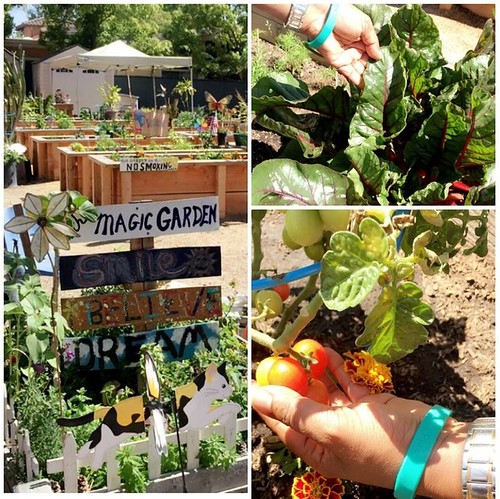
A collage of the Magic Garden
Taste preferences and eating habits are formed early in a child’s life, making CACFP a critical part of establishing healthy habits that will last a lifetime.
Through its 15 nutrition assistance programs, USDA strives to improve access to safe, healthy food for all Americans. The Child and Adult Care Food Program (CACFP) provides aid to child and adult care centers and family or group day care homes for the provision of nutritious foods that contribute to the wellness, healthy growth, and development of young children and the health and wellness of older adults and chronically impaired disabled persons. CACFP administrators and program operators receive support from many advocacy organizations who help ensure children and adults participating in CACFP receive nutritious meals. Below is a story from one of those advocacy organizations, the Child Care Food Program Roundtable.
By Chris Clark, Child Care Food Program Roundtable
In 2015, First Lady Michelle Obama’s initiative to end childhood obesity, Let’s Move!, celebrated its fifth anniversary. To mark the occasion, she issued the #GimmeFive challenge which encouraged all Americans to do five things to lead a healthier lifestyle. The Child and Adult Care Food Program (CACFP) community heard this call to action and developed its own CACFP Take ACTION Challenge. That Challenge was launched at the 2015 CCFP Roundtable Conference, where over 500 conference attendees got up, got moving and performed the #GimmeFive Dance!
The Challenge is a yearlong initiative aimed at creating national CACFP awareness, including its collaborative role in quality child care, healthy children, food security and childhood obesity prevention. It recognizes and celebrates CACFP participants’ and professionals’ efforts to get over 1.9 billion CACFP healthy meals and snacks served in family child care homes, centers and after school programs to over 3.8 million children and adults each year.
It consists of five categories, each with a list of corresponding activities. Categories include CACFP Take Action Launch, USDA Resources and Best Practices, Health and Wellness, Educate and Advocate and CACFP Campaigns. Participants select the activities they are interested in undertaking, complete the activities, take a picture and tell their story. At the end of the Challenge—at the 2016 CCFP Roundtable Conference in Rancho Mirage, Calif. – the following awards will be presented: CACFP Gold, Silver, Bronze and Commended.
To date, submissions have been received from child care providers, sponsors, USDA and state agencies in over 35 states. Additional challenge partners are: Child Care Food Program Roundtable; Food Research Action Center (FRAC); Team FNV; Let’s Move! Child Care; T & L Foundation; California Department of Education; National Farm to School Network and USDA. Some fun and creative examples of Challenge submissions received to date include:
  • Involving kids in taste testing recipes and creating their own recipe books to take home
  • Forming intramural sports teams and exercising together at work
  • Getting infants and young kids moving by listening to the Fruit and Veggie Swag collection of songs and videos
  • Inspiring others to join the Challenge through friendly competition
  • Starting a boot camp style fitness program for friends and colleagues
Building a healthy culture calls for action within and across sectors, because progress in one area will advance progress in another. CACFP, you are doing it! Thank you!
For more wonderful Challenge stories, visit:  www.cacfptakeactionchallenge.org. For details about CACFP, please see: www.fns.usda.gov/cacfp/child-and-adult-care-food-program. To learn more about the Child Care Food Program Roundtable, go to www.ccfproundtable.org.